“How much does custom software actually cost?” This is one of the most common questions businesses in Pakistan ask before starting a software project.
The problem is that there is no single answer.
Many prices found online are shown in USD and are based on Western development rates. These prices do not always reflect what it actually costs to build software in Pakistan. This can make it difficult for businesses to set a realistic budget before a project begins.
This article looks at three important parts of custom software development:
- What custom software realistically costs in Pakistan today
- How long a custom software project can take
- How AI is changing development costs and timelines
It also separates the real impact of AI from the claims often made about AI-powered development.
What Custom Software Actually Costs in Pakistan
There is no fixed price for custom software. The final cost depends on what you need to build and how complex the project is.
Here are some general cost ranges:
| Project Tier | What's Typically Included | Cost Range (PKR) |
|---|---|---|
| Simple | Basic user login, dashboard, and profile management | PKR 300,000 – 600,000 |
| Medium Complexity | Custom features and a few third-party integrations | PKR 500,000 – 1,500,000 |
| Enterprise-Grade | Large-scale systems, complex workflows, and multiple integrations | PKR 1,500,000 – 5,000,000+ |
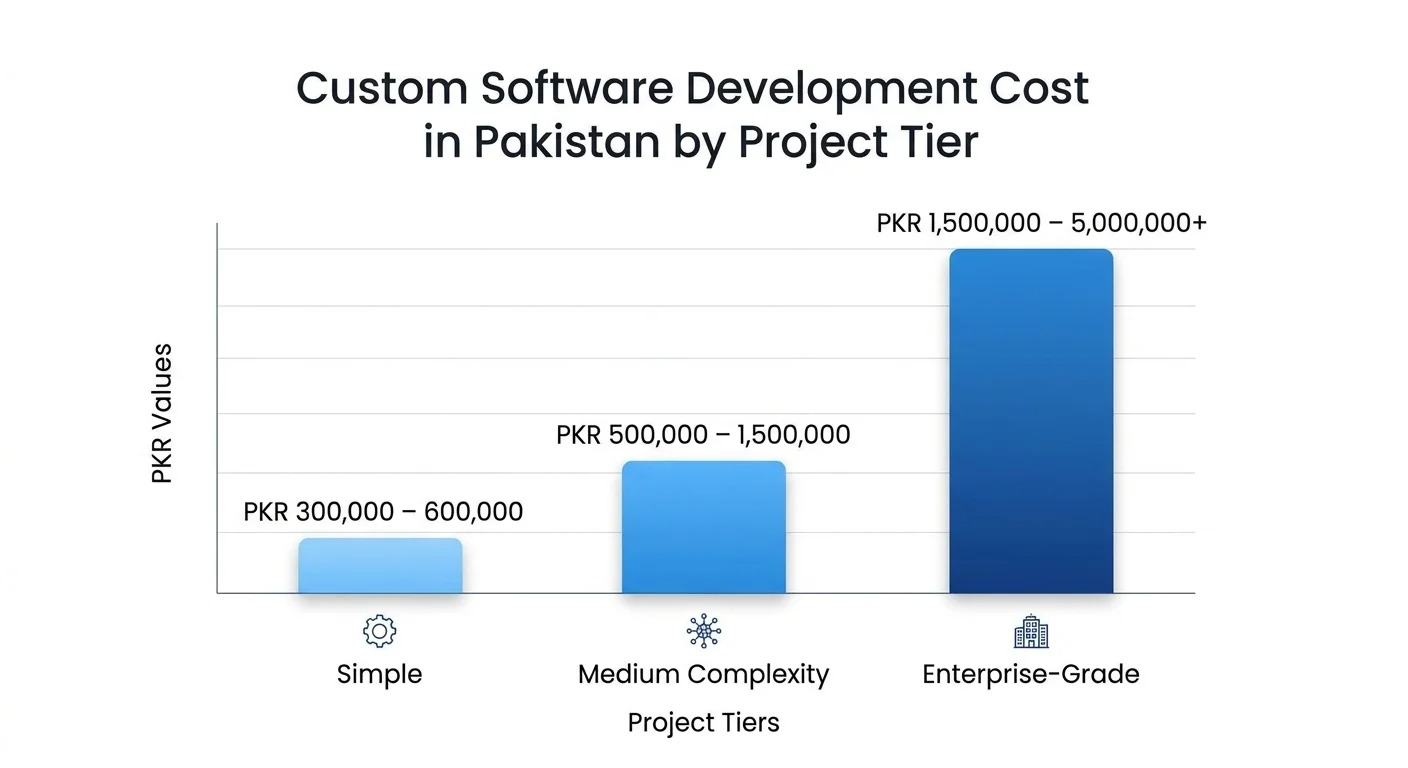
The main reason a project moves from the lower end of the price range to the higher end is often complexity.
For example, adding a payment gateway such as JazzCash or EasyPaisa takes extra development work. Building a custom backend instead of using an existing solution also adds time and cost.
The same is true when your software needs to connect with an existing ERP, CRM, or another business system.
Two businesses may describe their projects as “the same app” but receive very different quotes.
Why?
Because the complexity is not always in the basic idea. It is often in everything the software needs to connect with and how those systems need to work together.
Where Budgets Actually Go Off Track
The biggest risk is not always the starting price.
The bigger problem is what happens after development begins.
More than half of software projects, around 52.7%, go over their original budget by at least 89%.
This is not a small or unusual problem.
One of the main reasons is unclear project requirements. Unclear scope and requirements are linked to around a third of project failures. Scope uncertainty alone is also responsible for around 60–70% of budget overruns.
In many cases, this has a bigger impact than the technology, team size, or location of the development team.

In real projects, the problem often starts like this:
A business begins with a general idea. Development starts before all the details are clear. Then, during development, new requirements start appearing.
“Can we add this feature?”
“Can we also connect this system?”
“What about adding this option?”
Each request may seem small. But when many small changes are added together, they can have a major effect on the budget and timeline.
Soon, the final cost may look very different from the original quote.
The good news is that much of this can be avoided.
A proper discovery and planning phase before development starts can help define:
- What the software needs to do
- Who will use it
- What features are required
- Which systems it needs to connect with
- What the project should include and exclude
This planning usually costs much less than making major changes in the middle of development.
How Long Custom Software Realistically Takes
Budget and timeline are closely connected.
Many software projects go wrong because businesses expect development to happen much faster than it realistically can.
A real custom MVP usually needs at least 6 to 8 weeks.
This means an actual custom product, not a template with a few changes.
If someone promises a fully custom software product in only two weeks, you should look closely at what they are actually offering. It may be heavily based on templates or a no-code solution rather than a fully custom build.
Medium-complexity projects usually take several months.
Enterprise software can take even longer because it often involves more features, integrations, testing, users, and people involved in decision-making.
There is also another important question businesses should ask before starting:
Do you actually need custom software?
Not every business problem needs a custom-built system.
Sometimes an existing software product can be configured to meet your needs. It may solve the problem much faster and at a much lower cost.
Making this decision before setting a budget and timeline can save months of unnecessary development.
What AI Is Actually Changing About Cost and Timelines
AI coding tools are now widely used by software developers.
Around 84% to 92% of developers use AI tools regularly, and AI is involved in creating a growing amount of software code.
Because of this, many people assume AI is making software development dramatically faster and cheaper.
The reality is more balanced.
Current data suggests that AI coding tools can improve productivity by around 10–30%.
That is a useful improvement, but it is very different from claims that AI can make development “10x faster.”
One controlled study shows why AI’s impact needs to be understood carefully.
Experienced developers working on complex tasks with AI tools actually took 19% longer to complete those tasks. At the same time, they believed the AI had made them about 20% faster.
This shows an important difference between how fast AI feels and how much time it actually saves.
AI can be very useful for clearly defined and repetitive tasks, such as:
- Writing basic code
- Creating documentation
- Generating simple test cases
- Handling repetitive development work
But more complex tasks still require experienced human judgment.
Software architecture, difficult problem-solving, and major technical decisions cannot simply be handed over to AI.
In some cases, trying to use AI for these tasks can actually make development slower.
This is why choosing the right software development company is not simply about finding the team that can write code the fastest.
It is about knowing where AI can help and where human experience is still needed.
The best development process uses AI where it provides a real advantage instead of assuming it will make every part of the project faster.
The Cost Nobody Budgets For After Launch
There is another side of AI that businesses often overlook.
AI does not only affect how quickly software is developed. It can also increase the cost of building the final product.
AI-powered features such as recommendation systems, predictive analytics, and generative content tools can add around 10–20% to the total project cost for medium and large software projects.
This is because adding AI features requires additional development and integration work.
This is important when planning your software budget.
Using AI tools to help developers write code is not the same as adding AI features to your final product.
These are two separate things.
AI coding tools may help developers work more efficiently. But if your software itself needs AI features, those features require additional planning, development, testing, and maintenance.
So businesses should treat AI features as a separate part of the project budget, just like a payment integration or third-party API.
Assuming that “AI” automatically makes the entire project cheaper can lead to unrealistic expectations.
Where AI Adds Cost, Not Just Speed
Many businesses focus only on the initial development cost.
They receive a quote, approve the budget, and think about getting the software launched.
But there are also costs after launch.
Ongoing software maintenance typically costs around 15–25% of the original development cost each year.
This can include:
- Security updates
- Hosting
- Bug fixes
- Performance monitoring
- Small feature updates
- Technical maintenance
These costs continue after the software goes live.
For example, if your software costs PKR 800,000 to build, the real long-term cost is not just PKR 800,000.
You may also spend around PKR 120,000–200,000 every year on maintenance while the software remains in use.
There is another cost that can appear as your business grows.
A system that works well for a small team or customer base may start struggling as the business becomes larger.
You may notice:
- Slower performance
- More manual workarounds
- Temporary fixes becoming permanent
- Systems that no longer match how your business operates
Growth can expose problems that were not visible when the software was first launched.
The key point is simple:
A realistic software budget should cover the full life of the product, not just the initial development.
Final Thoughts
The real cost of custom software is much more than the number on the first quote.
It includes the decisions you make before development starts. It includes having a realistic timeline instead of rushing the project.
It also means understanding AI correctly.
AI can make some development tasks faster, but it can also add costs when you build AI-powered features into the final product. It does not automatically make every software project faster and cheaper.
You also need to plan for the years after launch, not just the weeks before the software goes live.
Businesses that plan for all of these factors are less likely to face major budget problems.
They do not avoid cost overruns because they are lucky. They avoid them because they treat the budget as the starting point of proper planning, not the final step.
A realistic budget, clear scope, proper timeline, and long-term maintenance plan can make the entire software development process much easier to manage.
Final Thoughts
SEO has not died because of AI.
What has changed is what visibility means.
In the past, ranking was the main goal. Now, ranking is only the starting point. It is still important, but it does not guarantee a click, an AI citation, or even that a customer will find your business.
Businesses that are losing traffic without understanding why are often still measuring SEO the old way: looking mainly at rankings and total clicks.
The businesses adapting well are not abandoning SEO.
They are building on it.
They use rankings as the foundation, structure their content so AI systems can easily understand and use it, and build enough authority for their brand to be cited by name rather than simply indexed.
The data shows that search has changed.
What has not changed is that businesses that pay attention to how search is changing are the ones that have the best chance of continuing to get found.