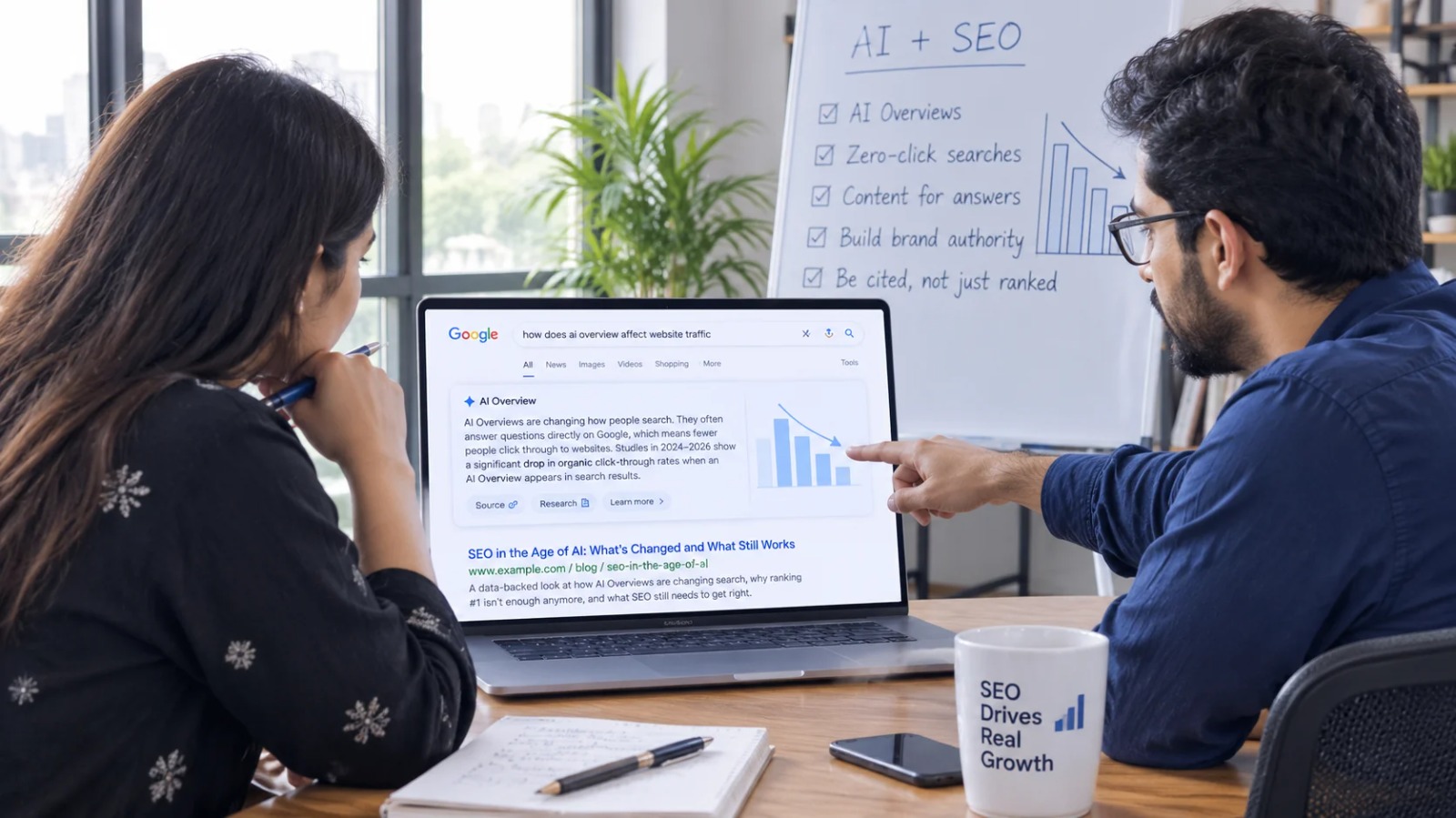
Search has changed a lot in 2026. This is not just an assumption. Several major studies have tracked these changes and found the same pattern.
Seer Interactive studied 5.47 million searches across 53 brands for more than a year. Ahrefs analyzed hundreds of thousands of keywords. Another randomized field study looked at the direct effect of AI overviews on clicks.
All three studies point to the same result: when an AI Overview appears in search results, fewer people click through to a website.
Most businesses have already noticed this drop. But what is less clear is what is happening behind those numbers. Where is the traffic drop slowing down? Where is it still getting worse? And what SEO strategies continue to work despite these changes?
This article looks at the data behind the rise of AI Overviews, explains why ranking #1 no longer guarantees the same visibility it once did, and shows what SEO still needs to get right in today’s search environment.
The Click-Through Collapse - What the Data Actually Shows
The numbers behind this change are bigger than many business owners might expect.
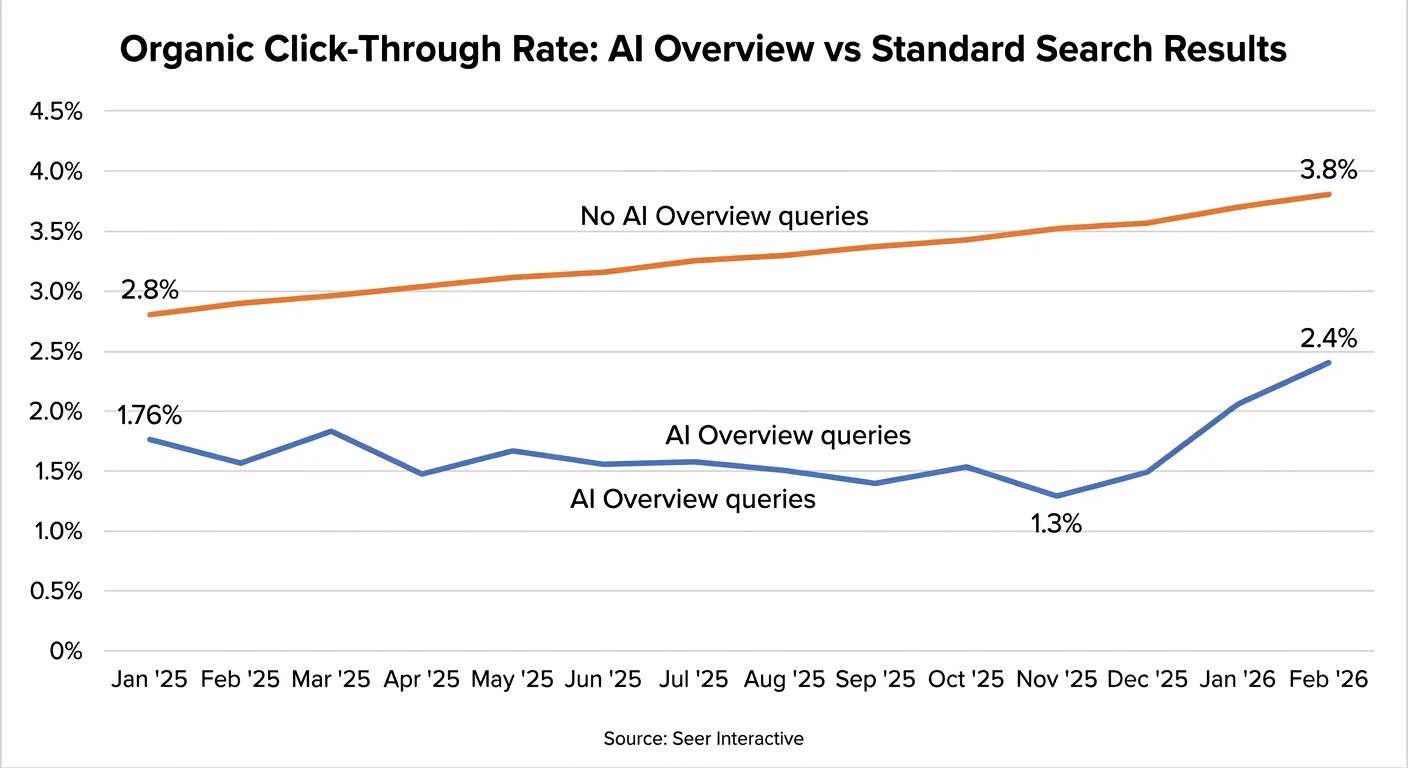
Seer Interactive tracked 53 brands, 5.47 million queries, and 2.43 billion impressions over 14 months. Its study found that organic click-through rate for searches with an AI Overview fell from 1.76% to 0.61%.
That means the chance of someone clicking through to a website after a search dropped by 61%.
Ahrefs found a similar result from a different set of data. Its analysis of hundreds of thousands of keywords showed that the click-through rate for the top-ranking page dropped by 58% when an AI Overview appeared above it.
The strongest evidence comes from a randomized field experiment carried out in early 2026.
Instead of only looking at a connection between AI Overviews and fewer clicks, researchers randomly removed AI Overviews for one group of users while keeping them for another group.
The result was clear: organic clicks dropped by 38% because of the AI Overview itself, rather than another factor happening at the same time.
The same study also found that zero-click searches increased from 54% to 72%. These are searches where people get the information they need without clicking on a website.
Three different studies used three different research methods, but they reached the same conclusion:
When an AI Overview appears, fewer people click through to websites.
It's Not a Straight Line - The Recovery Nobody's Talking About
If we only looked at the 61% drop in clicks, it would be easy to think that the decline is getting worse every day.
But the data tells a more complicated story.
The same Seer Interactive study that showed the initial drop also found some recovery. Organic CTR for searches with an AI Overview reached its lowest point at around 1.3% in December 2025. By February 2026, it had climbed back to 2.4%.
That is an 85% increase in just two months.
At first, that sounds like good news. And on its own, it is.
But there is another side to the data.
During the same period, CTR for searches without an AI Overview also increased. It rose from 2.8% to 3.8%, which was even faster.
So the gap between searches with and without AI Overviews is not getting smaller. It is getting wider.
What does this mean for businesses?
Search is no longer one single experience. It is becoming two different types of search:
- Searches where AI gives the answer directly on the results page.
- Searches where users are still expected to click through to a website.
Businesses that simply assume traffic is “recovering” without checking which type of search their keywords belong to may be making decisions without the full picture.
Ranking #1 No Longer Guarantees Visibility
For most of SEO’s history, the goal was simple: rank at the top and get the clicks.
That connection is no longer as strong as it used to be.
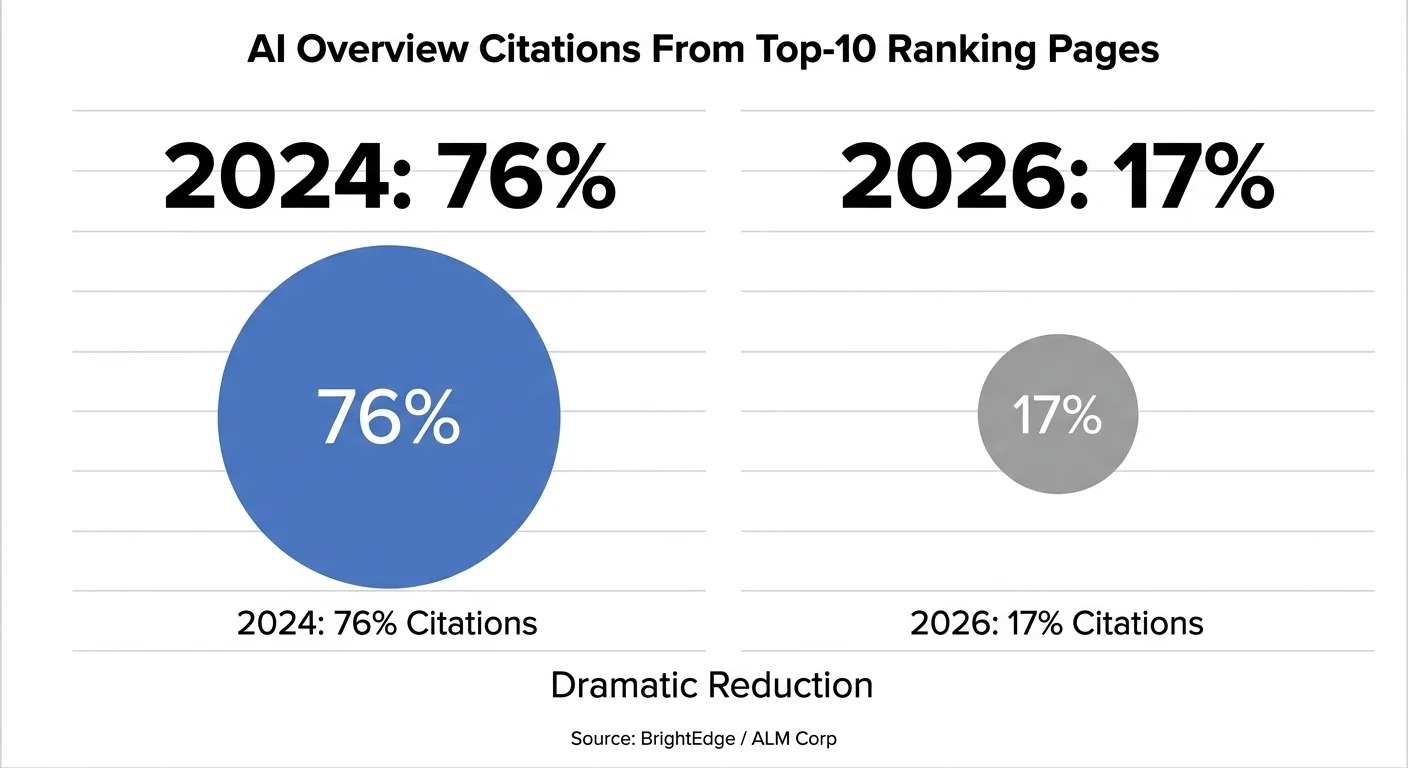
In 2024, about 76% of AI Overview citations came from pages that also ranked in Google’s traditional top 10 results.
By 2026, that figure had fallen to just 17%.
This means the page ranking at position #1 is now much less likely to be the same page that Google’s AI Overview uses as a source.
This matters because being cited can now be just as important as ranking.
Brands that are cited inside an AI Overview receive around 120% more organic clicks than brands that appear on the same search results page but are not cited.
So two businesses can rank for the same keyword and still receive very different amounts of traffic. One may get more clicks because the AI Overview chooses to mention and reference it.
This is something many SEO strategies have not fully adjusted to yet.
Ranking is still important, but ranking alone is no longer enough.
The question is no longer only:
“Am I ranking?”
It is also:
“Would an AI system use my content as a source for its answer?”
That requires a different type of optimization. It starts with making your website easy for AI systems to understand and cite in AI search engines.
Where Businesses Are Losing the Most Visibility
Not every industry is affected by AI Overviews in the same way.
The difference can be large enough to change how a business should plan its SEO strategy.
AI Overview trigger rates vary widely by industry:
- Healthcare: 88%
- Education: 83%
- B2B technology: 82%
- Restaurants: 78%
- E-commerce: around 4%
There is a reason for this pattern.
Industries that depend on informational, advice-based, or comparison searches are more likely to trigger AI Overviews. These are also the types of searches that many service businesses depend on.
For example, someone may search for advice, compare services, or ask a question about a problem they have. AI can often provide an answer directly on the search page.
E-commerce searches are different. They are often transactional searches such as “buy,” “price,” or “near me.” AI systems are much less likely to answer these searches directly.
This puts service businesses and B2B companies in some of the highest-exposure categories.
For many of these businesses, this is not a future problem. It is already affecting their search traffic.
And Google is not the only place where this is happening.
People are also asking many of the same questions directly in tools such as ChatGPT and Perplexity. This can reduce the need to visit Google in the first place.
If your business is not appearing in those AI-generated answers, you may have another visibility problem to solve.
More people are also asking questions directly inside ChatGPT and other AI tools instead of Google.
What Still Works - SEO Isn't Dead, It's the Foundation
None of these changes mean SEO has stopped working.
It means the role of SEO has become bigger.
A simple three-layer framework helps explain where SEO stands today:
SEO makes a page eligible. AEO makes the answer extractable. GEO makes the brand citeable.
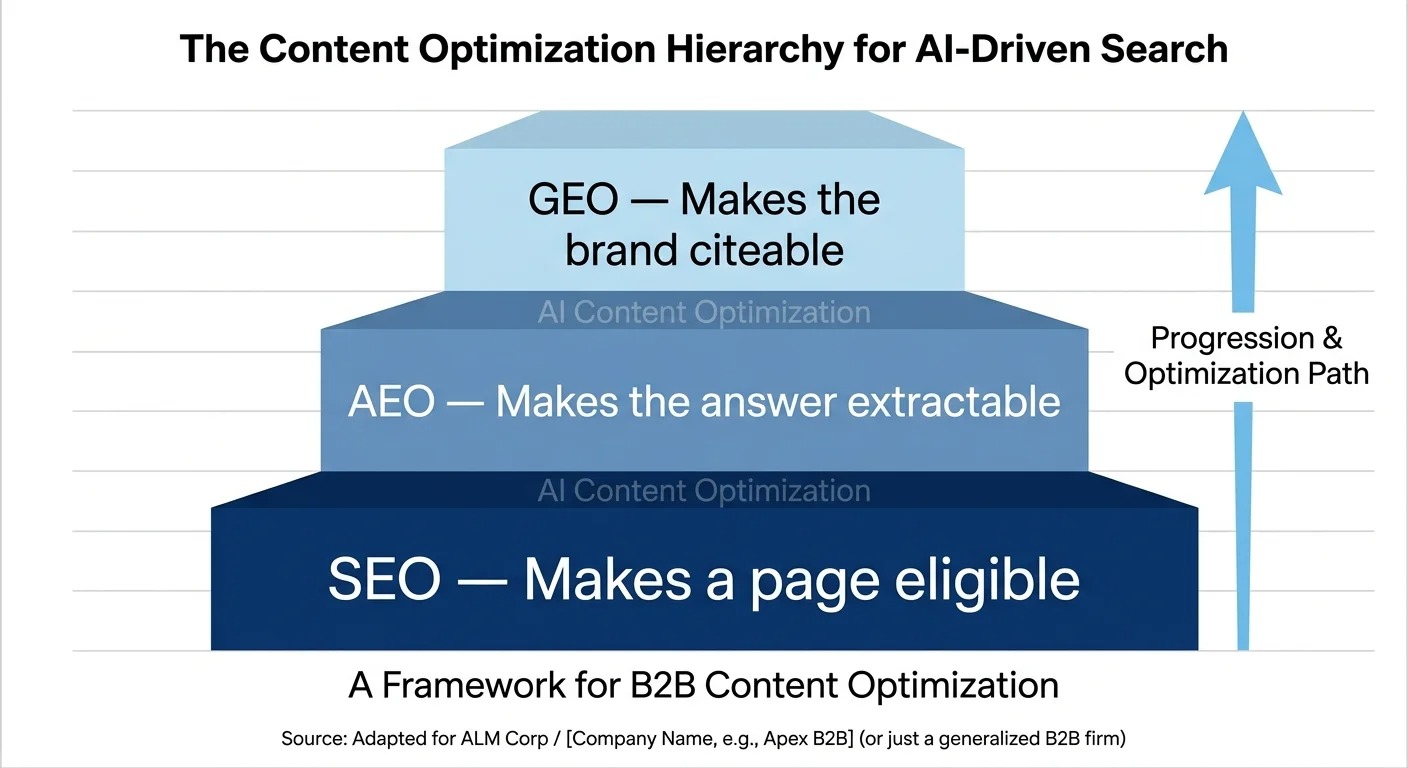
SEO is still the foundation.
Pages still need to be crawlable and properly indexed. Websites still need strong topical authority and trustworthy content.
AI systems do not get their information from nowhere. They still rely heavily on signals of relevance and trust, many of which have always been important in traditional SEO.
What has changed is what comes on top of that foundation.
AEO, or Answer Engine Optimization, focuses on making content easy for AI systems to take and use as a direct answer.
This means using clear headings, giving direct answers to specific questions, and organizing content around the way people actually search and ask questions.
GEO, or Generative Engine Optimization, takes this a step further.
The goal is to make your brand recognizable and trustworthy enough for AI systems to mention and cite it by name, rather than simply finding and indexing your website.
For most businesses, this does not mean abandoning SEO and starting from scratch.
Instead, it means building on what already works.
A strong SEO strategy still needs the right technical foundation, well-structured content, and strong authority signals. These elements help determine whether your website can perform well in both traditional and AI-driven search.
That is why traditional SEO alone may not be enough anymore. Understanding what AEO and GEO actually add can help identify the gaps in a typical SEO strategy.
Final Thoughts
SEO has not died because of AI.
What has changed is what visibility means.
In the past, ranking was the main goal. Now, ranking is only the starting point. It is still important, but it does not guarantee a click, an AI citation, or even that a customer will find your business.
Businesses that are losing traffic without understanding why are often still measuring SEO the old way: looking mainly at rankings and total clicks.
The businesses adapting well are not abandoning SEO.
They are building on it.
They use rankings as the foundation, structure their content so AI systems can easily understand and use it, and build enough authority for their brand to be cited by name rather than simply indexed.
The data shows that search has changed.
What has not changed is that businesses that pay attention to how search is changing are the ones that have the best chance of continuing to get found.