Most businesses do not know what a good website conversion rate actually looks like.
They know whether sales are going well or slowing down, but they may not know if their website is performing above or below a realistic benchmark. Because of this, many conversations about “fixing the website” start with guesses instead of actual numbers.
This article explains the real numbers behind website conversions, what counts as a conversion, what a good conversion rate looks like, and why getting more traffic will not always solve a conversion problem.
It also looks at why Pakistan’s mobile-first market makes website performance even more important and what may actually be causing businesses to lose leads.
What Is a Website Conversion, Exactly?
A conversion is any action you want a website visitor to take.
For some businesses, that means making a purchase. For others, it could be:
- Filling out a contact form
- Calling the business
- Booking a consultation
- Signing up for a newsletter
- Requesting a quote
In simple terms, a conversion happens when someone moves from just browsing to taking a specific action that matters to the business.
There is also an important difference between conversion rate (CVR) and click-through rate (CTR).
CTR tells you how many people click on a link or ad after seeing it. This happens before they reach your website.
CVR tells you how many people who actually visit your website complete the action you want.
So, if an ad has a high CTR but the website has a low CVR, the ad may be doing its job. The problem may be what happens after people reach the website.
What's Actually a Good Conversion Rate?
Here is a useful benchmark that many businesses are missing.
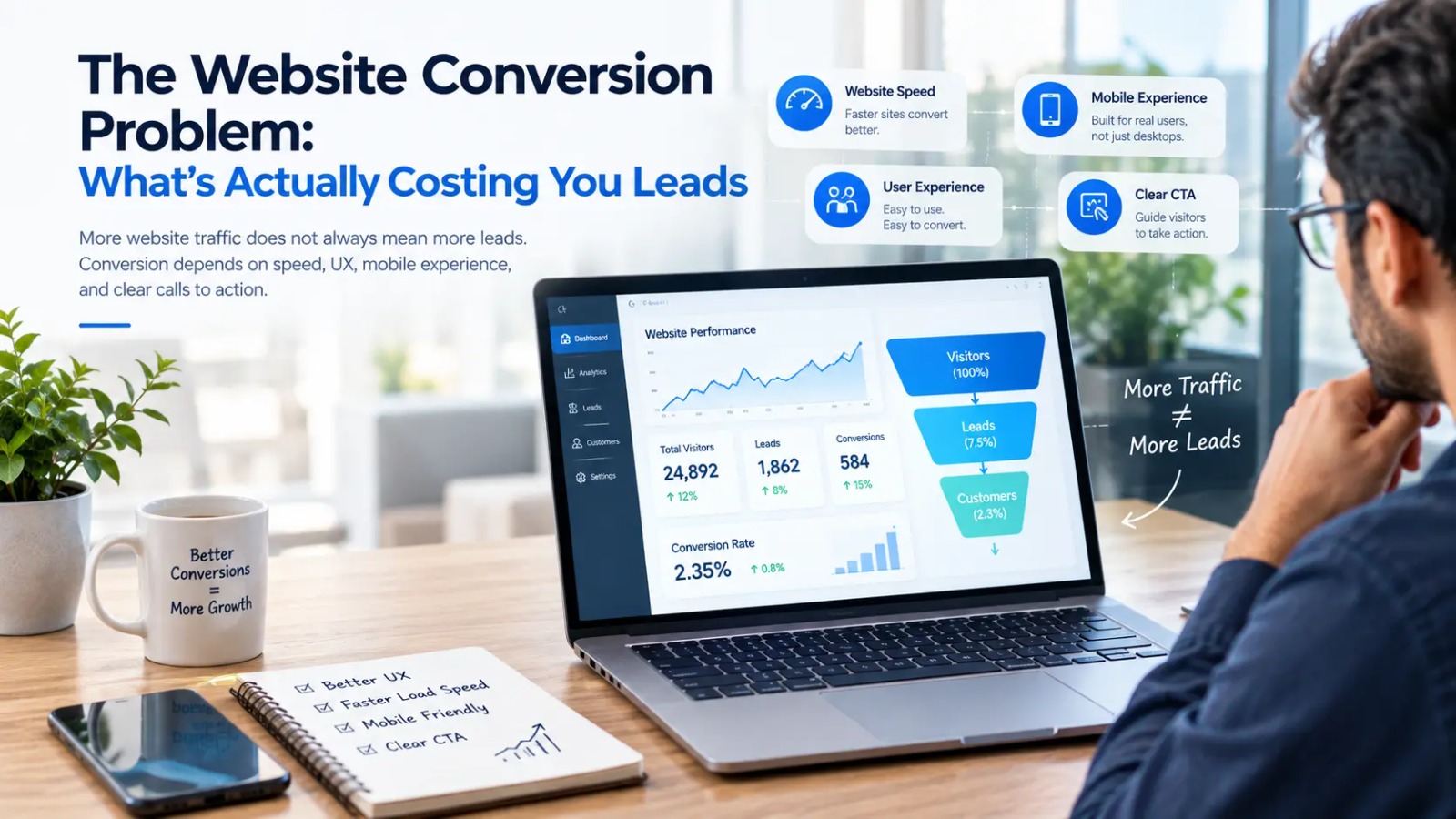
The average website conversion rate across industries is 2.35%, based on Contentsquare’s analysis of 46 billion sessions.
In simple terms, out of every 100 website visitors, around 2 to 3 complete the action the business wants them to take.
But the average does not tell the whole story.
The top 25% of websites convert at 5.31% or higher, while the top 10% convert at 11.45% or higher.

So, if you are wondering whether a 12% conversion rate is good, the answer is yes.
A 12% conversion rate puts a website around or above the top 10% level. That is genuinely strong performance, not just an average result.
However, conversion rates can also vary depending on the type of business.
B2B websites, for example, usually have lower conversion rates than e-commerce or consumer websites. B2B websites may convert around 2.3% of visitors into leads.
That does not automatically mean there is a problem.
B2B purchases usually take longer. More research may be involved, and several people may need to be part of the decision before someone finally fills out a form.
So, a lower conversion rate does not always mean the website is performing badly.
Why More Traffic Doesn't Fix a Conversion Problem
When a website is not generating enough leads, many businesses immediately think they need more traffic.
They increase ad spending, launch more campaigns, or post more on social media.
It sounds logical, but it does not always solve the real problem.
Suppose your website has a 1.5% conversion rate. Doubling your traffic does not fix that 1.5%.
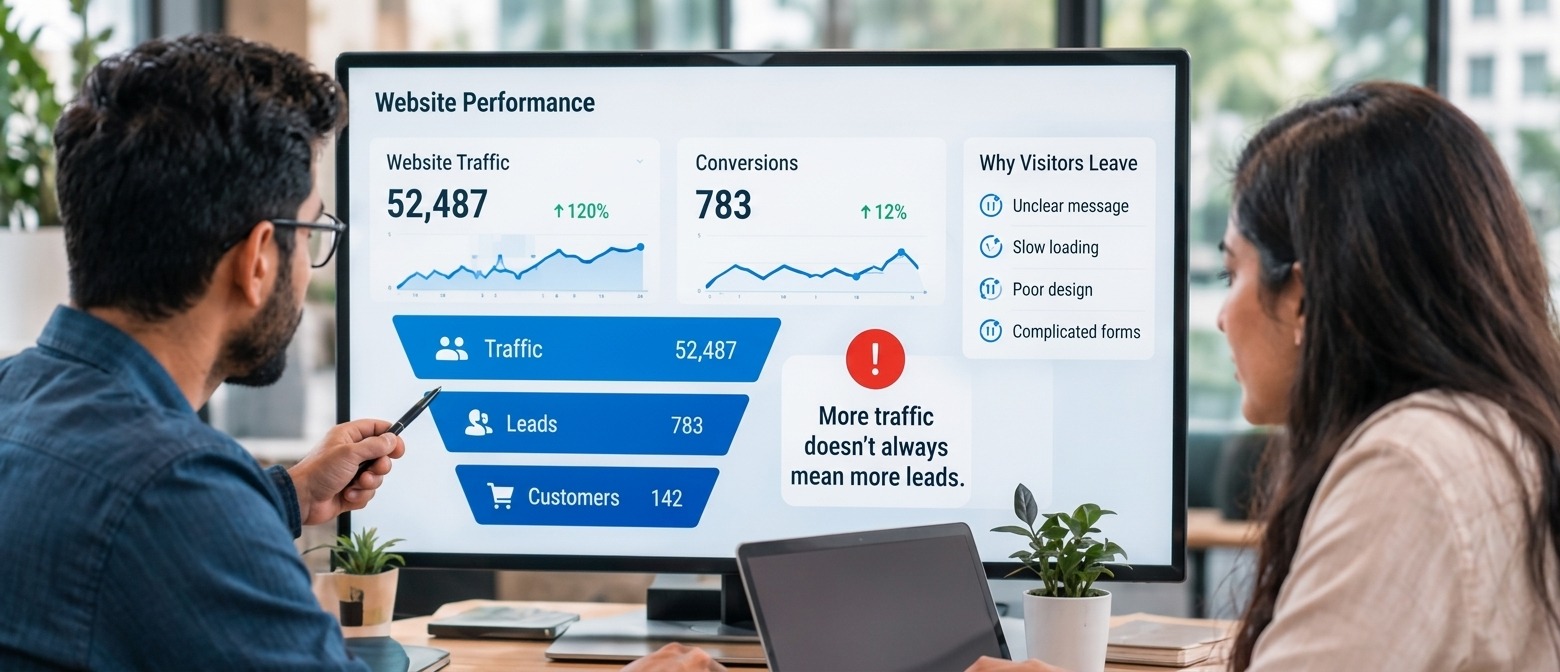
You simply get twice as many people visiting the same website and potentially leaving without taking action.
The conversion rate may stay the same. In some cases, it can even become worse because paid traffic may be less qualified than organic or referral traffic. A weak website can have an even harder time converting visitors who are not already strongly interested in your business.
The important difference is this:
A traffic problem means not enough people are finding your website.
A conversion problem means people are finding your website, but the website is not convincing them to take the next step.
Spending more money on traffic when the real problem is conversion is like making a message louder when people cannot understand the message. More volume does not make the message clearer.
Pakistan Is a Mobile-First Market — Is Your Website Built Like One?
Conversion benchmarks are useful, but you also need to consider how people in your market actually use the internet.
In Pakistan, mobile is a major part of that experience.
There are around 117 million internet users in Pakistan, and most people connect through mobile broadband instead of desktop.
Pakistan’s e-commerce market is worth around $6.5 billion and is projected to reach $9 billion by 2026. Digital payment transaction volume has also grown by 77% year over year.

People are not just browsing websites on their phones anymore. They are increasingly completing purchases and payments through mobile devices too.
This changes what a “good website” needs to look like for businesses in Pakistan.
A website may look great on a desktop, but if it loads slowly on a phone, feels difficult to use, or has buttons that are hard to tap, it can lose a large part of its potential audience.
Mobile is not a secondary version of the website that you can worry about later.
In Pakistan, mobile is a major part of the main customer experience.
What's Actually Killing Your Conversions?
Once you understand the benchmark and the importance of mobile, the next question is simple:
Why is the website not converting better?
The data points to several specific problems.
Load Speed Is a Major Problem
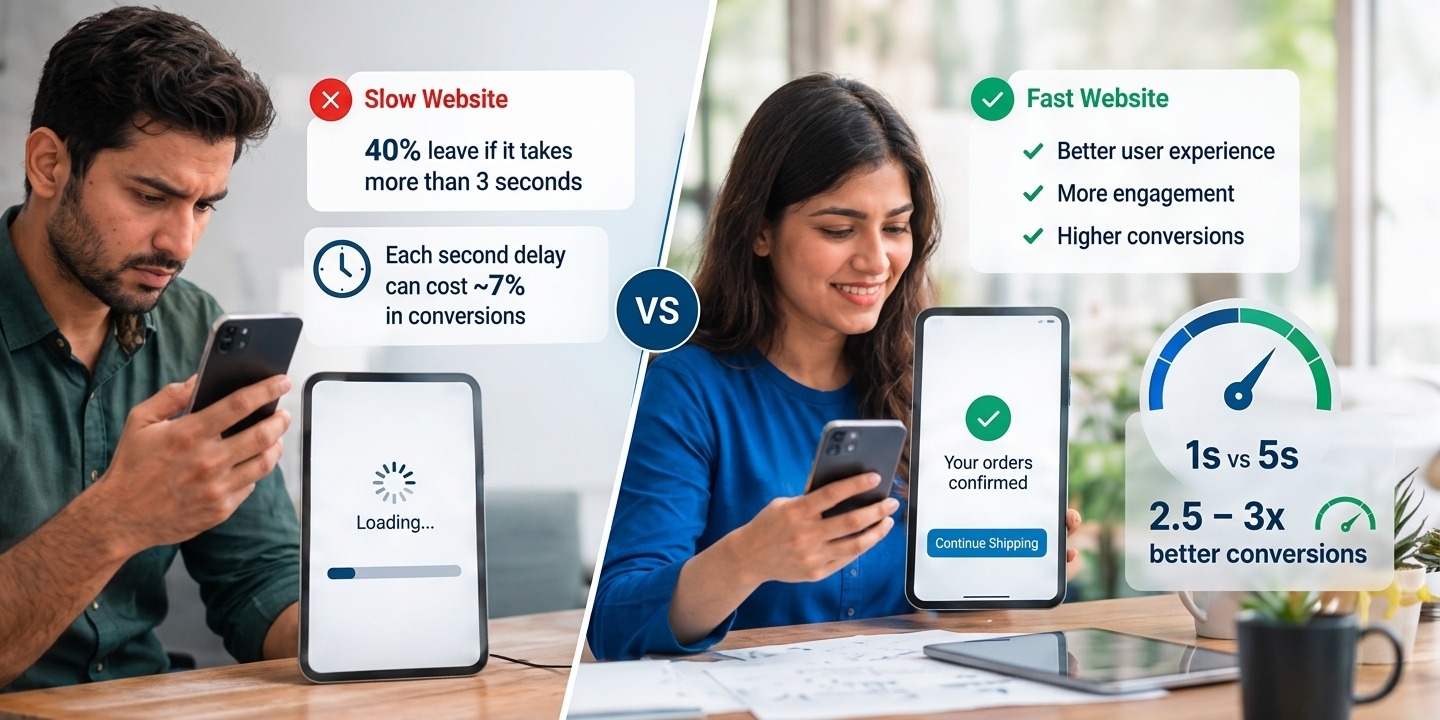
Around 40% of visitors leave a website if it takes more than 3 seconds to load.
Every additional second of delay can cost roughly 7% in conversions.
The difference can be significant. A page that loads in 1 second can convert 2.5 to 3 times better than a page that takes 5 seconds to load.
This is especially important in a mobile-first market such as Pakistan, where internet connection speeds can vary widely.
First Impressions Happen Very Quickly
People form an opinion about a website in around 0.05 seconds.
About 94% of that first impression is based on design.
That means visitors may judge your website before they even read your content.
A messy layout, poor spacing, outdated design, or inconsistent visual style can make someone leave before they have even read what your business offers.
Good UX Can Have a Big Return
Investing in user experience can also produce a strong return.
Businesses that invest properly in UX can see returns as high as 9,900% on that investment.
Research has also shown that putting just 10% of a development budget into UX can increase conversions by as much as 83%.
So, UX is not simply something that makes a website look nicer. It can be one of the most valuable investments a website can make.
This is the kind of foundation that proper web development services should get right from the beginning: speed, design, structure, and usability working together instead of being fixed later.
Should You Add an AI Chatbot?
AI chatbots are now a popular website feature for businesses trying to increase conversions.
But the data is mixed.
A chatbot is not automatically good or bad for conversions. Its results depend heavily on how it is used.
On the positive side, well-designed AI chatbots can increase conversion rates by 20% to 35%.
Personalized chatbot CTAs can convert up to 202% better than generic CTAs because they can respond to what a visitor is actually asking instead of showing the same message to everyone.
But there is also a downside.
Qualtrics’ 2026 research found that AI-powered customer service has a failure rate around 4 times higher than other AI use cases.
Even more importantly, 90% of consumers say their loyalty to a brand decreases when there is no clear way to reach a real person after using an AI chatbot.
A chatbot that gives unclear answers, keeps repeating itself, or cannot solve the customer’s problem can do more than fail to generate a lead. It can reduce trust in the business.
The main lesson is simple:
A chatbot is not automatically a conversion booster.
It can help when it provides useful answers and gives visitors an easy way to reach a real person when needed.
It can hurt when it is added just because AI is popular, without thinking about what the chatbot should actually do.
Whether AI chatbots on websites actually increase conversions depends heavily on how and why they are implemented.
When It's Actually Time to Redesign
Many businesses think about redesigning their website because it looks old, a competitor’s website looks better, or several years have passed since the last redesign.
But the data shows another important reason.
80.8% of businesses that redesign their websites do so because the website is failing to convert.
In other words, the main problem is often not how the website looks. It is what the website is failing to achieve.
This difference matters.
A redesign based on conversion data is a business decision with a clear goal.
A redesign based only on appearance is harder to justify because a modern-looking website does not automatically generate more leads.
Before redesigning, look at the numbers:
- Where does your conversion rate sit compared with the benchmark?
- How does your website perform on mobile?
- Where are visitors leaving?
- Which pages or steps are causing the biggest drop?
Without this information, you could spend money making the website look better while leaving the real conversion problems untouched.
Where to Start Improving Your Conversion Rate
Once you understand the benchmarks and common problems, the next question is:
Where should you start?
The answer is simple: check the data instead of guessing.
Start by checking your actual page load times. Do not assume the website is fast enough just because it feels fast on your computer.
Test the website on a real phone and a real internet connection.
Then look at where visitors are leaving your funnel.
For example:
- Are they leaving from the homepage?
- Are they abandoning the contact form halfway through?
- Are they leaving after landing on a page without scrolling?
- Are your calls to action clear?
- Does the visitor know what they should do next?
These checks can help you find the actual points of friction in your website.
Final Thoughts
A website conversion problem is rarely solved by the first solution that comes to mind.
More traffic may help, but it will not fix a website that cannot convert visitors.
A new design may improve the user experience, but it will not automatically generate more leads.
An AI chatbot may increase conversions, but only if it is useful and properly implemented.
The businesses getting the best results start with real numbers instead of guesses.
They check the things that are known to affect conversions, including website speed, first impressions, and mobile experience. They also make decisions about redesigns and AI chatbots based on actual data instead of trends or assumptions.
Your website does not need to be perfect to convert well.
It needs to remove the specific problems that are stopping visitors from becoming leads or customers.
And the first step is knowing where your website actually stands against a real benchmark, rather than simply assuming something is wrong.